
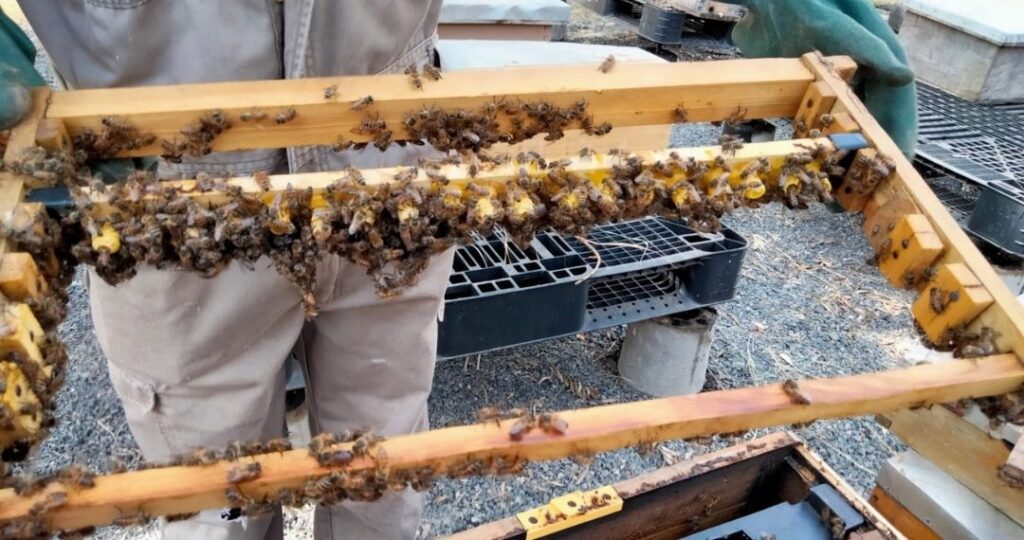
Todays beekeeping Vocabulary word is “Queen Rearing.”
Today’s beekeeping vocabulary word is “Queen Rearing.” by guest writer, Peter Maina Machira a leading Honey bee #queenrearing beekeeper in #queenrearingke
A hive is an investment with growing returns – YES – only if the bee colony grows! Colonizing hives – having honey bees take up residence in the hives – is one of the biggest challenges faced by beekeepers countrywide, and so raising your own honey bee queens, offers the beekeeper, profound control over the beekeeping venture.
At a minimum, it not only allows the beekeeper to possess colonized hives, since un-colonized – hives with no bees in them – means the beekeeper isn’t maximizing the use of the capital put into beekeeping. More importantly, however, It ALSO ENSURES the beekeeper can maintain healthy and productive bee colonies selected for various **DESIRABLE** traits. AND GROW honey bee populations!!!!.
How does the Beekeeper align with the natural instincts, and habits, of the Honey bees to get them to make queens?
……..Queen Biology……..
Irrespective of the method used, the process MUST follow the stages of honey bee biological development. Whether the bee develops into a queen or worker bee depends on the kind of food the larvae are fed by the worker nurse bees – MOST IMPORTANTLY the duration. Bee larvae, fed continuously on royal jelly, secreted by the glands in the head of the worker develop into queens.
……..Raising Queens in Nature……..
Bees will naturally raise their own queens to ensure the survival of their species. This will occur under three scenarios in which bees raise the queens and the beekeeper with a desire to raise queens should understand well to be successful.
……..Queens are raised by the bees under one of the following conditions……..
Swarming impulse (Crowded conditions ) …….Swarming is a natural phenomenon and is the bee colony’s method of reproduction and ensures the survival of their species. When a colony is preparing to swarm, bees build a large number of queen cells about 6 to12, but some strains build 20 or more. These are built on the sides or along the bottom of the comb in successive batches and are found in various stages of development. As a beekeeper, you can use swarm cells to re-queen colonies or introduce them to new colonies when making splits.
Emergency (Replacement of the queen)….when a queen dies suddenly or is killed accidentally during colony inspection. The bees discover her absence and will – go into emergency mode – begin quickly to raise a new queen from a few worker cells which contain eggs or larvae by enlarging and extending the worker cells – into Queen Cells – and feeding royal jelly to the selected larvae. Note: that when at times emergency queen cells are mistaken for swarming cells and if destroyed by the beekeeper, the bees will be queenless, and laying workers will develop in the hive. Caution needs to be taken when you get emergency cells. Make sure you see a queen or larvae at least two ripe cells as you make your splits.
Supersedure replacement of a failing queen…… when the queen becomes too old or infertile or has a physical mishap or diseased, the bees decide to raise a new queen to replace her with a young more efficient queen. They build only one to three queen cells in the center of the comb in which the original queen lays eggs; these are usually raised on the face of the comb and built as one hatch, all in a period of a few days. If a few cells are found on the face of a comb, and there are eggs present, these are supersedure cells and indicate a failing queen.
When the new queen emerges, the two queens exist together and do not fight with each other. The old queen will disappear from the hive within a few weeks.

……..How to Evaluate Donor Hives……..
Just like any livestock farming queen selection should be based on desirable traits, one wishes to propagate including ***Production*** – colonies that are best in honey production are good to choose from, ***Temperament*** – the reaction of a colony when it is approached, hive opened or otherwise disturbed can be a genetic trait. While Africanized bees are particularly known for their extremely defensive behavior. Gentle strains are especially important when keeping bees – and some are gentle! Other traits to consider when raising your queen are : ***Hygienic Characteristics*** / ***Propolizing Characteristics*** / ***Ability to Forage in Varying Climatic Conditions*** / ***Swarming Traits*** / ***Queen’s Egg Laying Ability***……
🙌 🌈 Well PRAISE BE! It’s about time more folks spread this message….BE ONE OF THEM ….Like and share … see you next Sunday for yet another Simon & Sons Vocabulary Sunday episode ….Do you have our number? You know, for when social media crashes again and you still wanna stay in touch, now you can text/ whatsapp/call +254732998655
Pop our # in your cell and shoot us a text to say hello! 👋