
Today, we ask what it means to clearly communicate when attempting to impart any kind of – beekeeping – knowledge. Yes, avoid flexible words which end up in mushy, unclear thinking, and miscommunication in the world of BEEdom.
I have got a feeling, an article about English to a beekeeping audience may not go down well with the readership, and may even be a fireable offense, like writing about integrity to the Kenyan politician. Nevertheless – I’m not easily deterred!
To clearly communicate – on beekeeping – one must appreciate that flexible words lead to mushy, unclear thinking, and unclear thinking, which in turn, leads to miscommunication.
So while bees communicate through dancing and pheromones, we humans communicate through language. We learn, discuss, and teach by using words we understand, words with meanings we agree on. Consequently, every hobby, trade, and field of inquiry has its own vocabulary that allows the participants to discuss and communicate the things that interest them.
Whenever attempting to impart any kind of knowledge – we owe it to our audience to use words they can understand without confusion, or don’t we anymore?
Beekeepers are no different. We have dictionary-length lists of specialty words that allow us to communicate with each other. But far too often, we use the same words for multiple things and wonder why new beekeepers are slow to catch on. A case in point is the word hive.
Can A hive be in a hive?
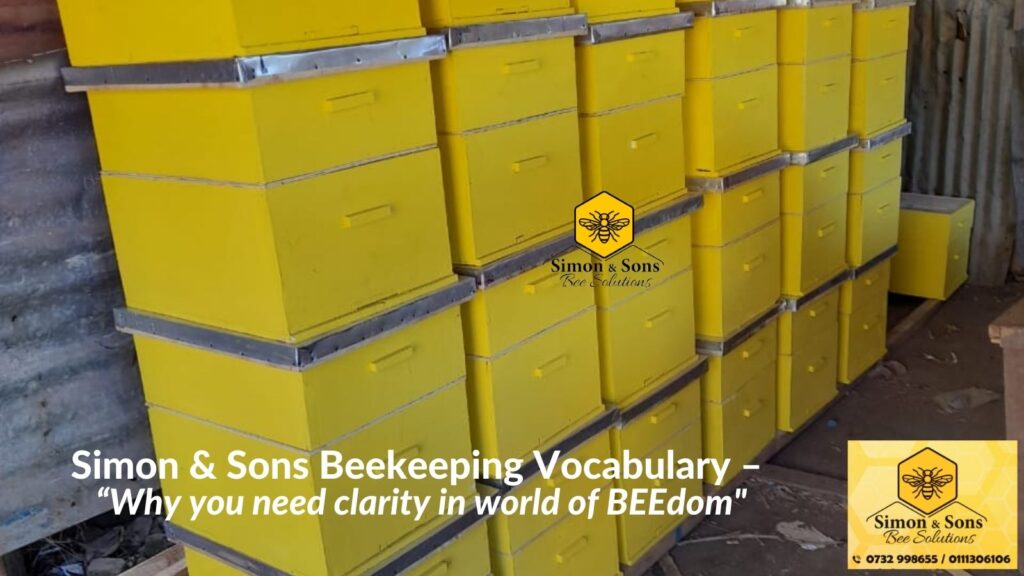
Today many beekeepers call everything a hive – the box, the colony, a swarm on a tree. Are all these hives? Longtime beekeepers will tell you clarification is unnecessary, that the meaning is clear – sure, I get that too! However, when teaching, mentoring, lecturing, or answering questions – whenever attempting to impart any kind of knowledge – we owe it to our audience to use words they can understand without confusion, or don’t we anymore?.
….And so…..while students live in dorms, soldiers live in barracks, and families live in hats, apartments, or tents. We seldom ask if the house on sale down the street includes the family. When your goat dies, you don’t say your hen died. When your horse dies, you don’t say your stable died. So, when your colony dies, why do you say your hive died? Most likely, that wooden box is doing fine.
I have an internal battle with sarcasm every time someone tells me their hive died. I want to ask how they knew, what the symptoms were, and how they disposed of it!
Keep it clear with unique words
Just like everyone else ~I suppose ~ many moons ago, when I began beekeeping, under the guidance of my mother, at times I thought hive was the correct word. Yet, it wasn’t until I began writing and mentoring that I realized how confusing it could be.
…and so…. whereas I’m not the arbiter of bee terminology, I can understand anyone using definitions that are different. That’s fine. But if you’re going to use the word hive for most things bee, at least give your new beekeeper friends a heads-up. Explain that when you say hive, you may mean the box, the colony, the box-colony combination, a swarm, the act of putting bees in a box, ……. Simply be crystal clear.

Respect your audience
Beekeepers aside, the proper use of words is generally respected in society. It shows regard for the listener, the one who is spending their time — and even money — listening or reading from you.
I’ll never forget interviewing for a job I really needed. During the interview, I used the word criteria incorrectly. I hesitated a moment and then said, “I meant criterion.” About a week into the job, the boss called me into her office and said, “Do you know why I hired you?” I had no clue and said so. “It’s because you corrected your own English,” she said. “It shows respect for your audience.”
I’ve thought about that a lot over the years. Sometimes we think we’re smart or cool or popular, but that’s not why new beekeepers come to us. They come because they want clear and uncluttered explanations using words they can understand. At the very least, we as mentors, teachers, or lecturers owe concise language to the people who depend on us.
What itches ….
Beginners are often brutalized by imprecise vocabulary, I’ll mention some.
Honey flow
As much as we might wish it, honey does not flow from flowers. The stuff that flows from flowers is nectar. Honey bees turn nectar into honey by doing things to it, things like spitting and mixing and drying. The term honey flow trivializes the role of the honey bee, making it sound like the honey is out there, fully formed, just waiting to be collected. I much prefer nectar flow.
Queen
I can understand Europeans capitalizing the word – queen – out of habit. In Kenya however, where we rebelled from the monarchy quite a while back, why do we think the word should be capitalized? In a beehive, a queen is not a title, but a job description like a traffic policeman, teacher, or carpenter. You can also think of it as a relationship like a mother, sister, or aunt, none of which are capitalized.
Queen cells
While some use the terms queen cell, supersedure cell, and swarm cell interchangeably. Sometimes the purpose of these cells is obvious. For example, when dozens of them are lined up at the bottom of the brood frames or several cells scattered on the face of the brood frames all these have different implications.
However, if you can’t determine the purpose, just call them queen cells. There’s no point in assigning a purpose to them if you don’t know what the purpose is. Using the wrong word just adds confusion to any discussion.
Enjoy Independence – responsibly
….and so….. I agree – after all these years – If you plan to keep bees in a vacuum, no one cares what you call anything.
But ….BUT …..BUT…..if you plan to teach, mentor, present, or write to beekeepers, especially new ones, try to use language that is clear and concise. Or so I think, and personally, keep trying!
Thank you so much for this content, it is educative.
Thank you Beata. It’s my passion to share the benefits of Beekeeping with all who are interested